
Romance of the Three Kingdoms VThe classic Macintosh game, with its music, on Mac OS X 10.4, in English and in Traditional Chinese.
Romance of the Three Kingdoms V (三國志V, KOEI, 1996) is the fifth of KOEI's grand strategy games set in the China of the Three Kingdoms. You take a warlord of the age, from Cao Cao to Liu Bei to a ruler of your own making, and work towards one China: 47 cities to govern and take, hundreds of officers with their faces and lives, seasons that turn, battles fought in formation, envoys, plots and duels, and a soundtrack of twenty pieces. The Power-Up Kit expands it. The Macintosh edition was only ever Japanese.
Here it is as a PowerPC Macintosh plays it today: the CD audio replaced by MP3 playback, so the music is there under emulation and from a hard disk; native on Mac OS X 10.4 without the Classic environment; and in English, down to the map's city names, the 500 biographies and the names you type. Each package holds both editions, the base game and the Power-Up Kit, for Mac OS 9, Mac OS X 10.4 or, since revision 4.7, a 68K Mac. A Traditional Chinese edition has begun as well, with the text and the font of KOEI's Chinese edition for DOS.
New to Romance of the Three Kingdoms V? This guide covers what makes it special, how a turn works, every part of the main screen, battles and how to win, with tips for a first campaign. At the end: the extras, what's new in the Power-Up Kit, and a short history of KOEI.
- Why play it
- The basics
- The main screen
- Giving orders
- Reputation and rice
- Battles
- How to win
- Tips for your first campaign
- Extras
- What's new in the Power-Up Kit
- A short history of KOEI
Why play it
- Formations decide battles. There are twelve, each with its own speed, strengths and best ground, and units have a front, so a charge into a flank or rear hits far harder than an attack head-on. The right formation on the right ground can beat a bigger army. This is what sets the fifth game apart from the rest of the series.
- Hundreds of historical figures. Every officer has a portrait, ratings, skills and formations, and 500 of them have a biography to read. They grow as they fight, learning new skills and formations with experience.
- Many ways to win. Conquer by force, make allies and research weapons together, turn enemy officers and governors with plots, or threaten weaker rulers into surrendering.
- Nothing is hidden. You can see every ruler's cities, officers and armies from the start, and so can they.
- Wandering sages such as Hua Tuo and Zuo Ci can join you for a while, with powers like healing your whole army or confusing the enemy's.
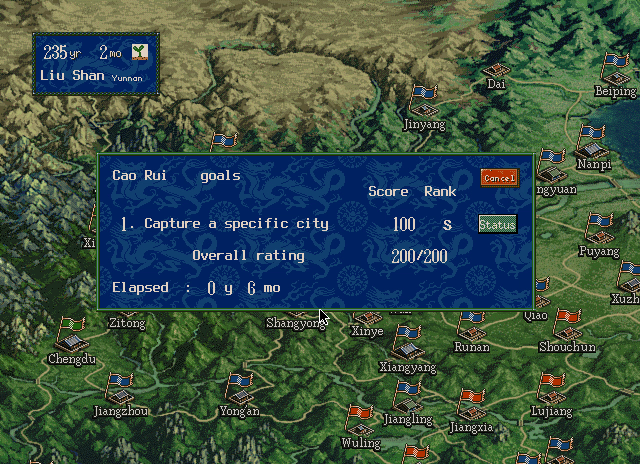
- Long games or short ones. Unifying China takes many evenings. The Power-Up Kit's goals make a shorter game with a score: one game reached an S rank in six months of game time.
- The music is by Takayuki Hattori.
The basics
The game is set in China at the end of the Han dynasty, between the Yellow Turban rebellion of 184 and the death of Zhuge Liang in 234. The empire has broken apart, and warlords fight over its 47 cities. You play one of them, and you win by bringing all of China under your rule.
Each turn is one month. In a month you get a handful of orders (the number next to the scroll on the panel) to develop your cities, move officers, send envoys, run plots or go to war. When you are done, Rest ends the month, and the other rulers, played by the computer, make their moves.
Your officers do the actual work. Each one has five ratings out of 100: WAR (fighting), INT (intelligence), POL (politics), CHA (charm) and LOY (loyalty to you). They also have an age, experience, energy that orders use up, the formations they know, and up to six of the game's 32 skills. Officers with low loyalty can be lured away by other rulers, and free officers who serve no one can be found and recruited.
Gold pays for troops, gifts, envoys and feasts. Food feeds your soldiers, at home and on campaign. Civil work develops a city's land, dikes, trade and walls.
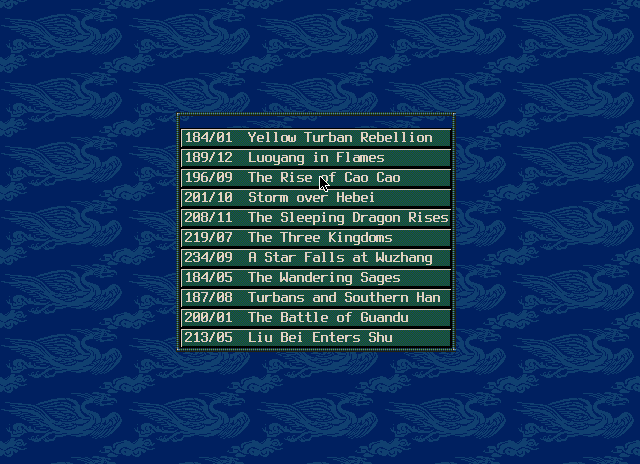
A new game starts with a scenario: a moment in history, with the rulers of the time and their officers where history placed them. The base game has seven, from Yellow Turban Rebellion (184) to A Star Falls at Wuzhang (234), and the Power-Up Kit adds four more. Then you pick a ruler, or several to play in turn, and the settings: historical or fictional mode, difficulty (Easy, Norm or Hard), whether new officers appear, whether battles are shown, and the sound.
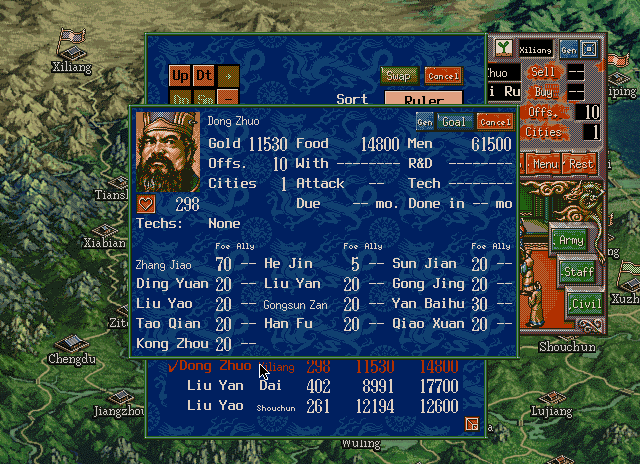
You can also play a ruler of your own. Register a new officer aged 15 or older from the first menu, and they can found a realm in a city you choose, with followers you choose.
The main screen
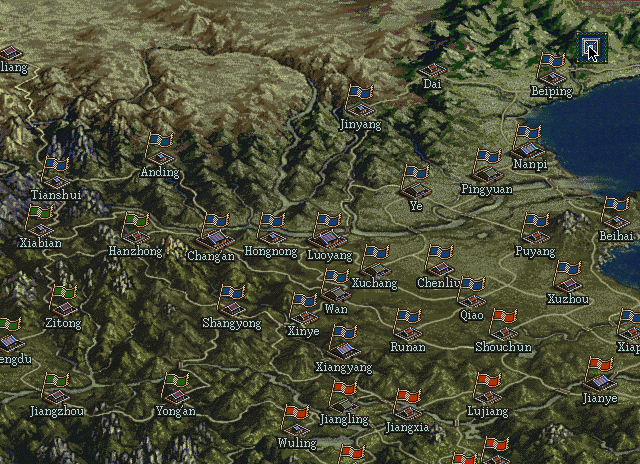
Every month starts on this screen: the map of China, with the current ruler's panel on top. The top of the panel shows the ruler's numbers; the hall below is where you give your officers their orders.
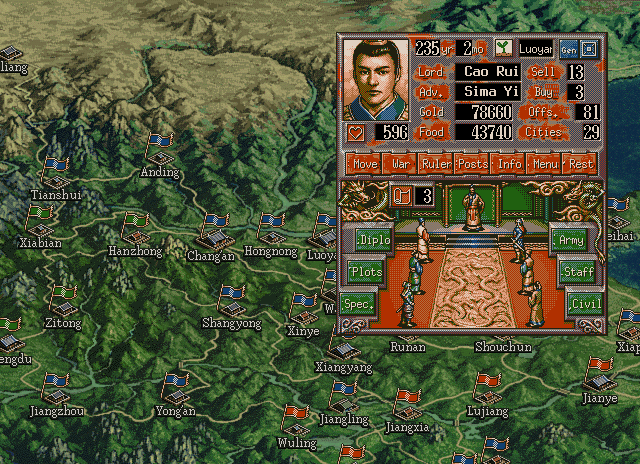
- 1Ruler. The ruler whose turn it is.
- 2Date. The year and month. Each turn is one month; this is February 235.
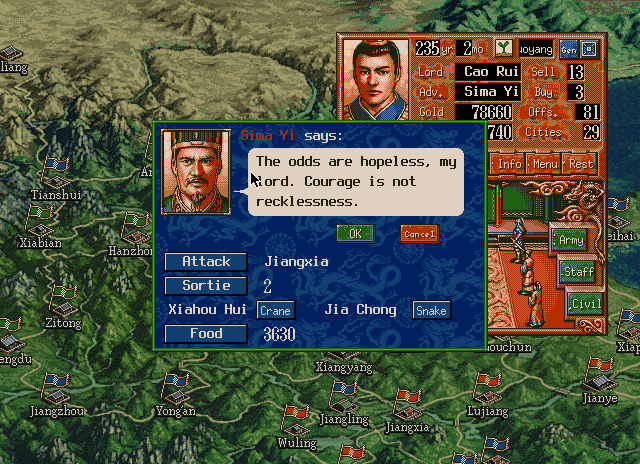
- 3Lord, adviser, gold, food. Your ruler and his adviser, who speaks up before risky orders, and the gold and food of your whole realm.
- 4Season. A small animation shows the season: a sprout, the sun, falling leaves or a snowflake. The map's colours change with the seasons too.
- 5Capital. Your capital, where the ruler lives (here Luoyang). Long names scroll through the box.
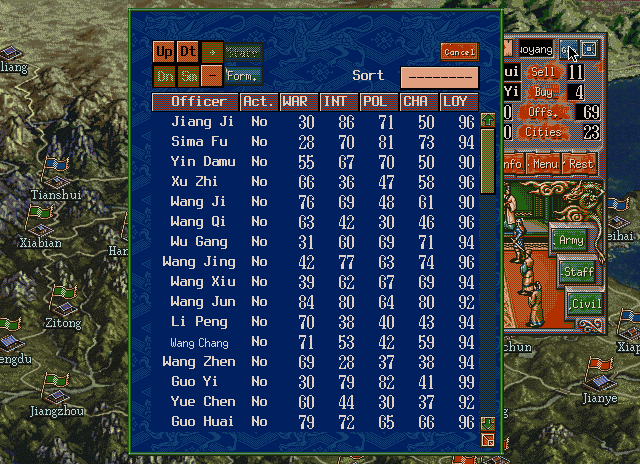
- 6Officer list. The Gen button lists all your officers with their ratings, and shows who has already acted this month.
- 7Hide panel. The small square hides the panel so you can see the whole map. Click it again to bring the panel back.
- 8Rice market. The merchants' rice prices: Sell is what you pay to buy rice, Buy is what you get for selling it. Two dashes mean you hold no market city. See Reputation and rice.
- 9Officers and cities. How many officers serve you, and how many cities you hold. All of China is 47.
- 10Reputation. The heart is your ruler's reputation. The higher it is, the more orders you get each month. See Reputation and rice.
- 11Commands. Your ruler's seven commands, explained below.
- 12Orders left. How many orders you have left this month. Every order uses one.
- 13The six posts. The audience hall. Each officer works in one of six posts: Diplo, Plots and Spec. on the left, Army, Staff and Civil on the right. Click a post to give its officers orders. Click the ruler on the throne to see the year's goal.
- 14A city. A city on the map, here Tianshui, with its castle, flag and name. Click a city to open it.
- 15Flag colour. Each ruler has a flag colour. Here blue is Cao Rui's Wei, green is Liu Shan's Shu and red is Sun Quan's Wu.
Giving orders
The row of seven buttons holds your ruler's own commands. The six buttons in the hall are the posts: each officer works in one post, and a post's commands are carried out by its officers in the city you pick. Every order uses up one of the month's orders, and most also cost the officer energy: 25 to move, 30 for most jobs, and 40 to march, plot or plant a spy.
The ruler's commands
 | Move officers from any of your cities to one city. |
|---|---|
 | Attack a neighbouring city: choose the target, the officers, and each unit's soldiers, food and formation. |
 |  Award: give an officer gold, for loyalty. Item: give an officer an item, or take one back. Posts: appoint your adviser, strategist, generals and governors, or dismiss an officer. Reorg: share out a city's soldiers among its officers. Feast: a banquet that restores a city's officers' energy (1,200 gold and 6,000 food). Award: give an officer gold, for loyalty. Item: give an officer an item, or take one back. Posts: appoint your adviser, strategist, generals and governors, or dismiss an officer. Reorg: share out a city's soldiers among its officers. Feast: a banquet that restores a city's officers' energy (1,200 gold and 6,000 food). |
 | Assign officers to posts, city by city. You can only change posts in January, so choose with care. |
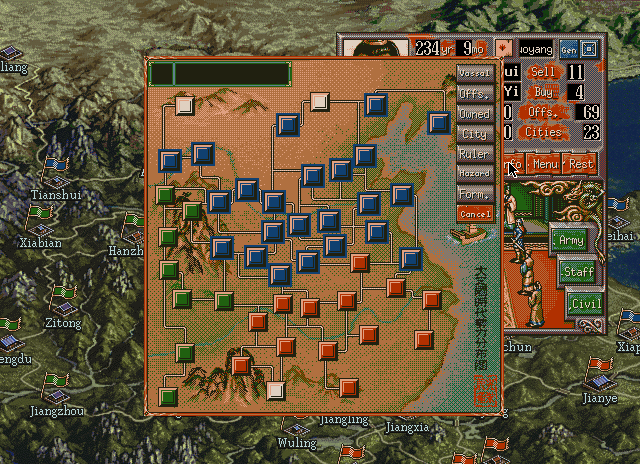
 | Look up rulers, cities and officers, starting from a map of China with every city in its ruler's colour and the roads between them. You can also read 500 officer biographies here. |
 |  Setup (the game's settings), Save, Load, Edit and End. Edit is in the Power-Up Kit only, and lets you change officers, cities and rulers by hand. Setup (the game's settings), Save, Load, Edit and End. Edit is in the Power-Up Kit only, and lets you change officers, cities and rulers by hand. |
 | End the month. |
The six posts
 | Develop a city's land, dikes, trade or walls. |
|---|---|
 |  Draft: conscript soldiers (lowers reputation). Hire: take on volunteers for gold. Drill: train your soldiers. Loot: take gold and food from the people (lowers reputation). Draft: conscript soldiers (lowers reputation). Hire: take on volunteers for gold. Drill: train your soldiers. Loot: take gold and food from the people (lowers reputation). |
 |  Seek: search a city for free officers. Recr.: send an envoy with gold to win over another ruler's officer. Seek: search a city for free officers. Recr.: send an envoy with gold to win over another ruler's officer. |
 |  Ally: propose an alliance. Joint: propose a joint attack. Gift: send gold to another ruler. Threat: demand surrender. R&D: research weapons with an ally, which strengthens some formations. Aid: ask a ruler for gold or food. Ally: propose an alliance. Joint: propose a joint attack. Gift: send gold to another ruler. Threat: demand surrender. R&D: research weapons with an ally, which strengthens some formations. Aid: ask a ruler for gold or food. |
 |  Rift: persuade an officer to change sides. Tiger: push a governor to break away from his ruler. Incite: stir up a city's people. Sabot.: weaken a city's defences. Rumor: turn a city's people against their lord. Rift: persuade an officer to change sides. Tiger: push a governor to break away from his ruler. Incite: stir up a city's people. Sabot.: weaken a city's defences. Rumor: turn a city's people against their lord. |
 |  Plant: send an officer to serve another ruler as your spy (needs loyalty 100). Quest: send an officer away for a year of training. Trade: buy or sell rice. Tour: visit a city to see to its people's loyalty. Plant: send an officer to serve another ruler as your spy (needs loyalty 100). Quest: send an officer away for a year of training. Trade: buy or sell rice. Tour: visit a city to see to its people's loyalty. |
Reputation and rice
Reputation
The heart under your ruler's portrait is his reputation, and it may be the most important number on the panel, because it sets how many orders you get each month. Below 300 you get three; the higher it climbs, the more you get, up to about ten at 1,000. A good name also helps your envoys, plots and recruiting.
Reputation rises mainly when you achieve the goal your council sets each January; a growing realm and some historical events help too. It falls when you draft soldiers, loot, execute prisoners or miss the year's goal. So hire volunteers rather than draft when you can afford it, recruit or release prisoners rather than execute them, and take the January goal seriously.
The rice market
Food comes from your cities, but you can also buy and sell it, though only in the few big cities that have merchants, such as Luoyang, Chang'an, Xuchang, Ye, Xiapi, Xiangyang, Jianye and Chengdu. Hold one of them and the panel shows the market's prices:
- Sell is the merchants' selling price: what you pay when you buy rice.
- Buy is the merchants' buying price: what you get when you sell rice.
Two dashes mean you hold no market city. Prices move with the harvest: in one game, Sell fell from 11 in September to 8 in December and was back up to 13 by February, while Buy dropped from 4 to 1 and recovered to 3. Buy rice when Sell is low, and sell it when Buy is high. The trading itself is done with Trade, under the Spec. post, by an officer in a market city.
Battles
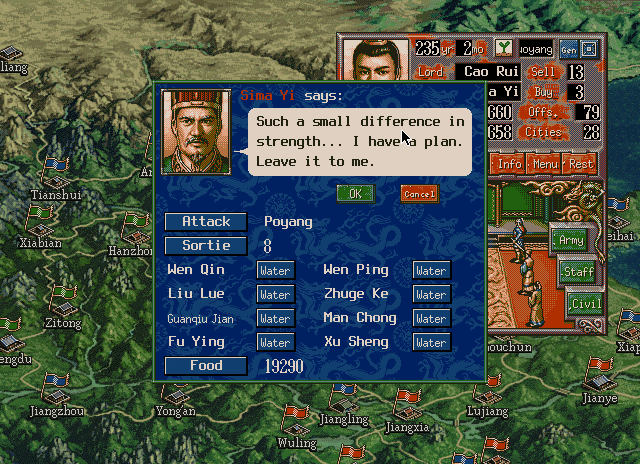
To attack, choose War, then the target city, the officers to send, and each unit's soldiers, food and formation. Before you confirm, read your adviser's comment: it sizes up the defenders and the help they can expect. Each side can field up to ten units.
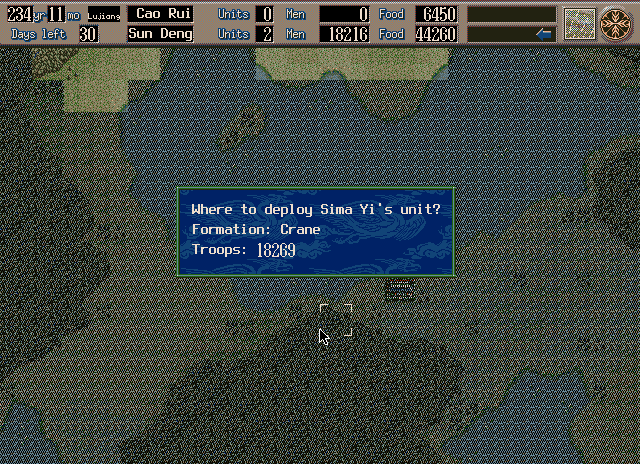
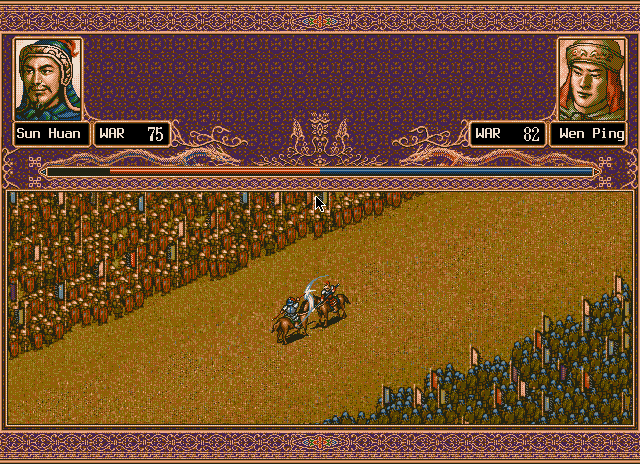
Battles are fought on their own map, day by day. The attacker has 30 days to win; when time runs out, the attack has failed, and running short of food hurts morale. From around day five the defender gets help from nearby cities, and later from their ruler's own army.
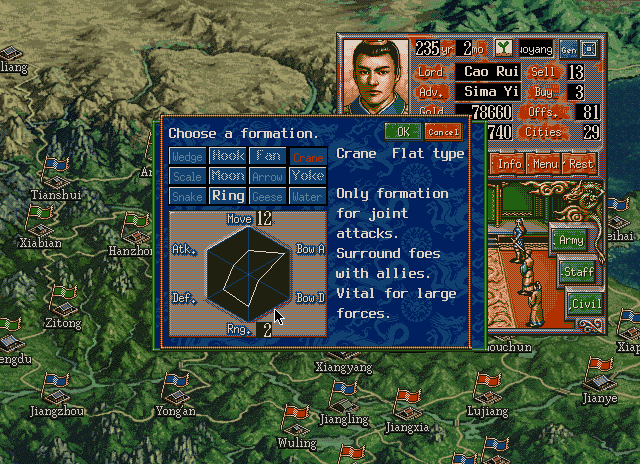
Each unit fights in a formation, and an officer can only use the formations they know. The formation chooser shows each one's strengths on a chart; the main roles are:
- Wedge: fast, for getting round the enemy on open ground.
- Arrow and Scale: charging, best into a flank or rear, or down from hills.
- Moon and Ring: strong at close quarters, good for holding the line.
- Crane: the only formation that can join neighbouring units in a combined attack.
- Hook and Geese: archery.
- Water: the only formation that moves well on rivers and lakes. Units in any other formation crawl there and get beaten.
Changing formation takes a unit's turn, so plan ahead. A classic move: march in Wedge, get beside the enemy, switch to Arrow and charge their flank, then switch to Moon or Ring before they hit back. Officers can also use tactics, and two officers may fight a duel, though a challenged officer can refuse.
A battle ends when one side's ruler is defeated, its army is wiped out or retreats, or the castle falls or holds out. The winner picks who stays to guard the city, then decides each prisoner's fate: Recruit, Release or Execute. In the settings you can have battles shown or skipped; in a shown battle, Auto lets the computer command one unit or all of them.
How to win
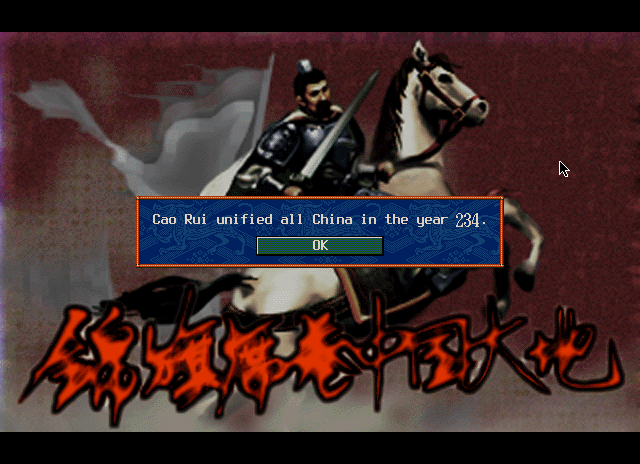
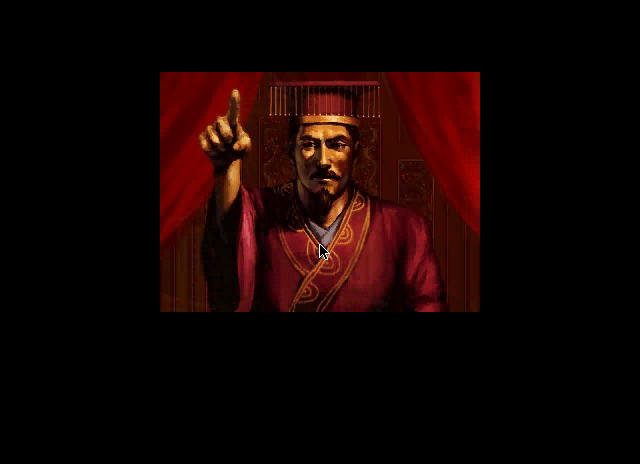
Unify China by holding all 47 cities. A ruler who loses his last city is out of the game. When the last city is yours, the game announces it at the end of the month and plays the ending: the unification scene, a landscape, a poem, the emperor, and The End.
You don't have to conquer everyone by force. A ruler who accepts your Threat surrenders his realm to you. In one game, Liu Shan and Sun Quan both gave in to Cao Rui's threats, and moving officers into the three cities they left empty finished the job.
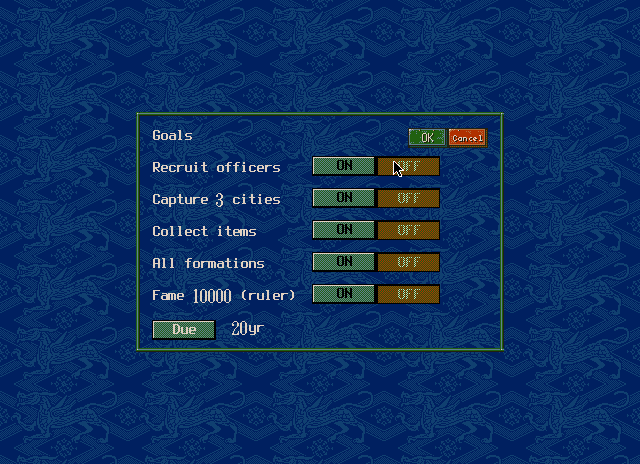
The Power-Up Kit also lets you play for goals. On the third screen of a new game you can switch on up to five: Recruit officers, Capture 3 cities, Collect items, All formations and Fame 10000 (ruler), and set a deadline (Due, 20 years at first). The game decides which officers, cities and items count. It ends when you meet the goals, with a score and rank for each, or when the deadline passes, and then asks whether you want to carry on and unify China.
If your ruler dies, you choose a successor and the realm carries on. You lose when your realm has no cities left.
Tips for your first campaign
- Choose your ground by your officers. Check which formations they know before you pick a direction. Officers with Water belong in the river country of the south, around Xiangyang, Jiangling and Wu; Wedge, Snake, Scale and Arrow do well on the plains and in the hills of the north and west.
- Set the posts carefully in January. They are fixed for a year. Put strong fighters in Army, and officers with good politics and charm in Staff.
- Keep loyalty high. Officers can be lured away from anywhere on the map, so raise new recruits' loyalty quickly with Award or an item. Your adviser recommends 95 or more; keep some gold ready when you recruit.
- Guard your reputation. It decides how many orders you get. Achieve the January goal, and draft, loot and execute as little as you can.
- Hold a market city early, so you can buy food for your armies when the harvest is not enough.
- Feast before a campaign. A banquet restores a city's officers' energy, and a march needs 40.
- Draw out the defenders' help. A city's neighbours send armies from about day five. Attack first with units you can spare, wait until no more help arrives, retreat, and strike again the same month with fresh officers: you will usually meet the garrison alone.
- Find an ally for research. R&D needs a partner, and makes some formations stronger.
Extras
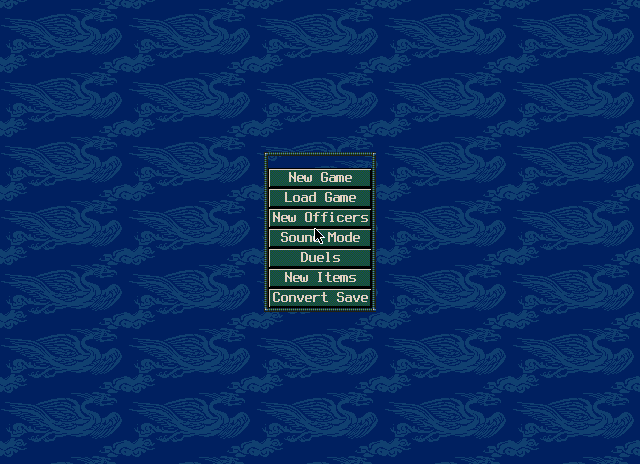
The first menu offers more than New Game and Load Game: the base game has four entries, the Power-Up Kit seven.
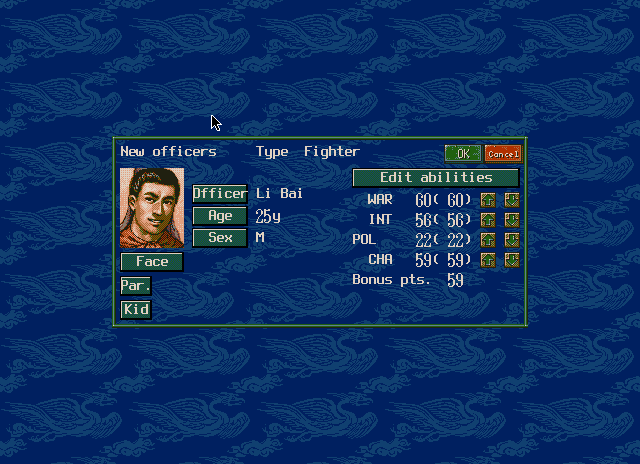
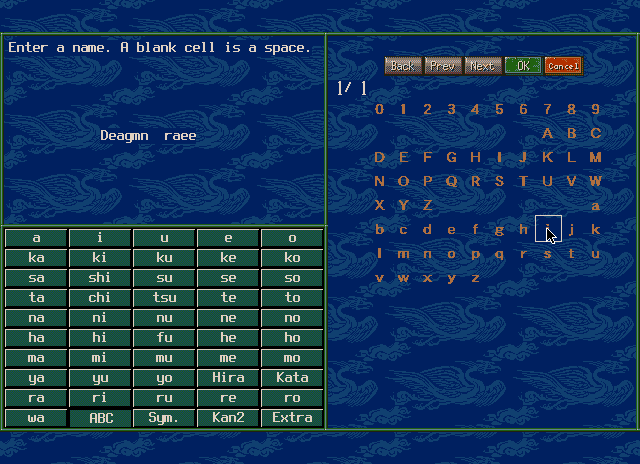
| New Officers | Create your own officers: a name of up to eight letters, age, sex, type, the four ratings (with bonus points to share out), family, and a face from the game's portraits. They can appear in your games, or found their own realms as new rulers. |
|---|---|
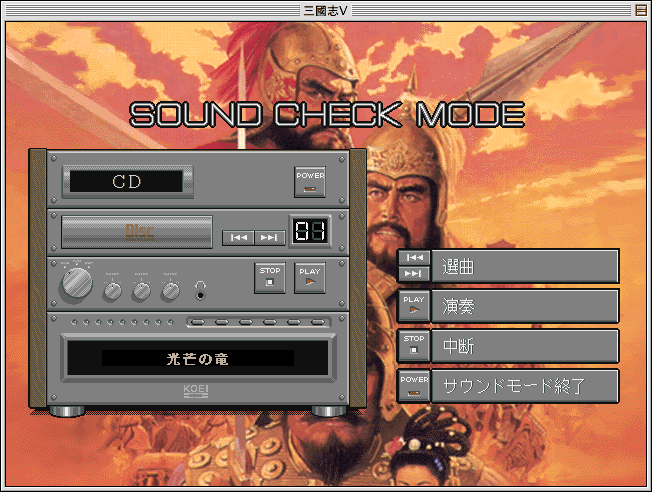
| Sound Mode | Sound Check Mode, the game's built-in CD player: pick any of the twenty pieces of music and play it. |
| Duels | Power-Up Kit only. Duels on their own, in five modes: Practice, Survival, Team Cup, Solo Cup and Top Ten. |
| New Items | Power-Up Kit only. Create your own items (a book, weapon, horse, medicine or seal), with a name of up to twelve letters and a picture. |
| Convert Save | Power-Up Kit only. Carry on a base-game save in the Kit. |
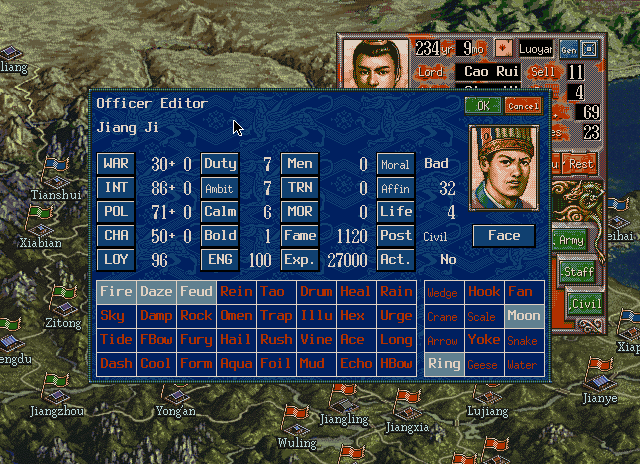
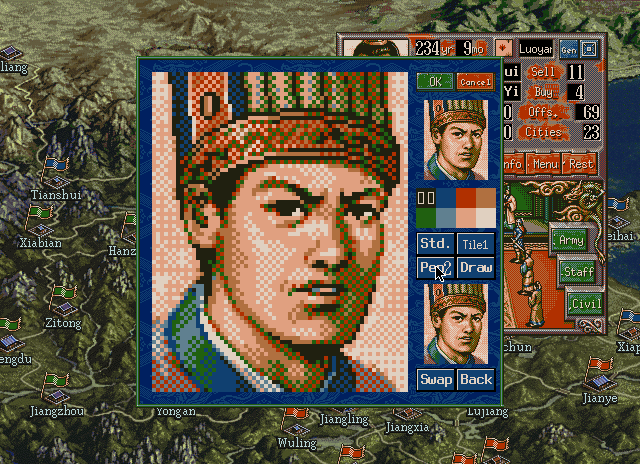
In the Power-Up Kit, Menu > Edit lets you change any officer, city or ruler in the middle of a game. Its Face button opens a pixel editor for portraits, with eight colours, pens and patterns.
The music is the twenty tracks of KOEI's soundtrack CD (December 1995): twelve by Takayuki Hattori, six by Tatsuo Matsui, and the short victory and defeat themes by KOEI's own music department.
What's new in the Power-Up Kit
The Power-Up Kit is KOEI's expansion. It is a separate program next to the base game, with its own saved games, and every download here includes both. It adds:
- Four new scenarios, eleven in all: 184/05 The Wandering Sages, 187/08 Turbans and Southern Han, 200/01 The Battle of Guandu and 213/05 Liu Bei Enters Shu.
- Goals: games with end conditions and a deadline, scored and ranked (see How to win).
- A duel mode, with tournaments and a top ten.
- New Items, for making your own items.
- Edit: change officers, cities and rulers during a game, faces included.
- Convert Save: carry on a base-game save in the Kit.
- More dialogue and messages.
- Opening and ending movies.
A short history of KOEI
- 1978
- Yoichi Erikawa and his wife Keiko found KOEI on 25 July in Ashikaga, Tochigi, as a dye and industrial chemicals business.
- 1981
- KOEI's first game, the wargame Kawanakajima no Kassen, comes out on cassette tape.
- 1983
- Nobunaga's Ambition (30 March) turns Japan's Warring States era into a strategy game. The series is still going.
- 1985
- Sangokushi (10 December), the first Romance of the Three Kingdoms. Kou Shibusawa, the producer's name on KOEI's historical games, is Yoichi Erikawa's pen name.
- 1988
- KOEI Corporation opens in California, and KOEI's games start coming out in English.
- 1995
- Sangokushi V comes out for the NEC PC-9801 (15 December), with music by Takayuki Hattori.
- 1996
- Windows versions, the Power-Up Kit (19 July, on the PC-98), the Sega Saturn version (27 September), and a Japanese edition for the Macintosh.
- 1997
- The PlayStation version (14 February). The same year, the fighting game Sangoku Musou starts what becomes the Dynasty Warriors series.
- 2000
- Shin Sangoku Musou (Dynasty Warriors 2) for the PlayStation 2 turns the Three Kingdoms into an action series.
- 2009
- KOEI and Tecmo merge under Koei Tecmo Holdings (1 April). A year later, on 1 April 2010, KOEI becomes Koei Tecmo Games.
- 2017
- Sangokushi V with Power-Up Kit is re-released on Steam (19 April).
- 2020
- Romance of the Three Kingdoms XIV, the fourteenth game in the series.
Sources: the game itself; the GameFAQs guide to the game by K.K.C. (2017); the Japanese Wikipedia articles コーエー and 三國志V; KOEI's page for the soundtrack CD.